Valorant lowest to highest rank challenge shows how a Radiant player dismantles every lobby from Iron upward
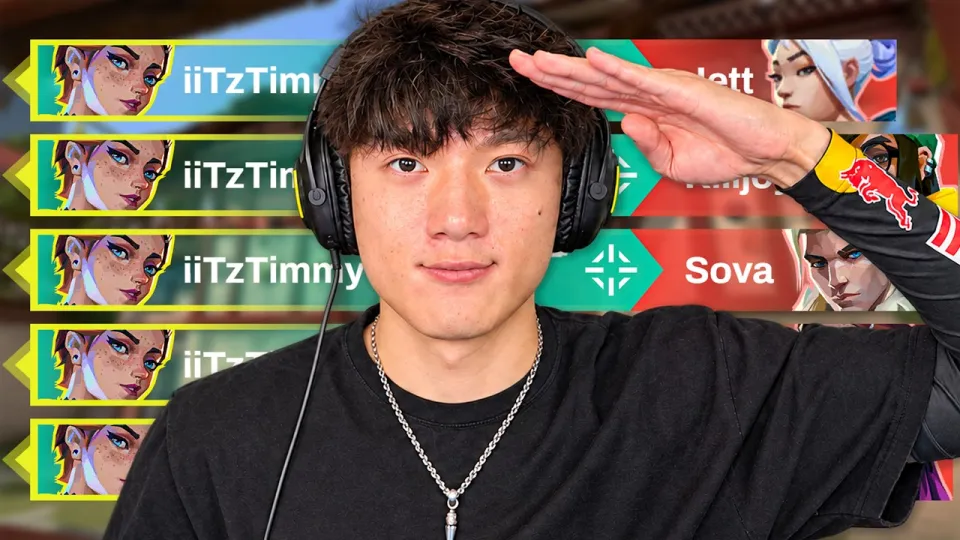
Video: I Might Be Getting TOO Good at Valorant… (Lowest To Highest Rank Challenge)
Want articles like this for your own video to promote it on YouTube and Google? Order them through the Telegram bot @sat_sit_bot. Articles with your video embedded are written and posted by the bot itself — on popular topical sites (no ads). Your first 50 articles are free.
· based on the channel iiTzTimmy Two
Valorant's lowest to highest rank challenge is a climb from the bottom of the ranked ladder to Radiant in one continuous run, and the iiTzTimmy Two video of that format shows the real dividing line is decision-making rather than aim. The same player who one-taps in Iron still has to call rotations, manage economy and keep five strangers pointed at the same site. You can watch the full climb live on iiTzTimmy's Twitch channel, where the ranked grind continues between edited uploads.
What the lowest to highest rank challenge actually tests in Valorant
The challenge removes the one variable most players blame for their rank: teammates. A Radiant-level player starting in Iron is not measuring whether they can win a duel, because they win almost every duel; the test is whether they can convert individual advantage into round wins fast enough to skip divisions before the account's hidden MMR catches up. That means playing the map instead of the scoreboard, taking early space, and closing rounds before the enemy team can stack utility.
In practice the run exposes three things that separate tiers far more than crosshair placement:
- Economy discipline. Buying every round in low elo loses games that aim alone would win, because a full-buy loss hands the opponent a free bonus round.
- Utility sequencing. Smokes, flashes and recon used before the entry rather than after it decide whether the first contact becomes a site take.
- Tempo. High-ranked players re-peek, rotate and re-take on a timer; lower-ranked lobbies stall after the first kill and let the defenders reset.
The Cypher who tilted over comms and proved the mental game point
The most instructive part of the opening game is not a highlight but a breakdown: a Cypher on the team becomes convinced nobody is communicating, then spends the rest of the match narrating his teammates' mistakes while making the first aggressive push himself. That combination — entrying alone and then blaming the team for the trade that never came — is the single most common pattern in low-to-mid elo Valorant.
The tell is invented information. Players under pressure start calling utility that was never used or a rotation that never happened, and the team plays around a fiction. A cage call that nobody confirmed is worse than silence, because silence at least keeps everyone on their own read. The fix is mechanical, not motivational: pick one player to call rotations, keep comms to enemy positions and utility spent, and stop reviewing teammates mid-round.
Why the second lobby played like a stream-snipe instead of a ranked match
The second game flips the dynamic. Once opponents recognise the name in the lobby, the match stops being ranked Valorant and becomes a series of personal duels — players peek angles they should not hold, chase kills across the map and force fights against a player who wins them. That produces the strange result where the climbing player's scoreline looks modest while the enemy team's aggression hands over rounds for free.
The practical lesson applies to any Valorant player facing a smurf or a known name: do not try to out-duel the best player on the server. Trade utility instead of aim, hold crossfires, and make the star player's duel a two-on-one. Ego peeking a better mechanical player is the fastest way to lose a winnable game.
The mechanics that still matter at the top of the ladder
Aim does not disappear at Radiant; it just stops being the differentiator. The run still leans on the fundamentals that scale all the way up:
- Counter-strafe timing. Stopping before the shot is what makes a flick repeatable, and it is the first habit that separates Gold from Platinum.
- Off-angle discipline. Holding the same pixel every round gets pre-fired; the climb depends on moving one step off the common angle.
- Ability-to-gun balance. Duelists who burn all utility before contact lose the trade; utility should create the duel, not replace it.
- Ult economy. An ultimate saved for a retake is worth more than one used for a highlight on a lost round.
The comments around the run repeatedly circle back to one question — sensitivity and DPI — and the honest answer is that copying a pro's settings imports their mouse control, not yours. Pick a sensitivity where a 180-degree turn fits inside a comfortable wrist or arm sweep, then never change it during a climb.
How to use the challenge format for your own ranked climb
Any Valorant player can run a smaller version of the challenge without a fresh account. The method is to treat each division as a checkpoint and change one habit per tier instead of rebuilding everything at once.
- Record five games and count how many rounds you die first without a trade.
- Pick the agent whose utility fixes that specific failure, not the agent with the highest pick rate.
- Set a round-one rule: no solo entry before the first utility lands.
- Review only losses where you had a positive K/D — those are the decision errors, not the aim errors.
- Stop queueing after two consecutive losses; tilt costs more rank than mechanics ever will.
Common questions about Valorant ranked climbs and the challenge format
Most doubts around this kind of run come from the same place: players assume the climb is a mechanics showcase, then see a high-ranked player win games with patience and economy. The rest of the confusion is about accounts, MMR and how quickly a strong player actually moves up divisions. The FAQ below covers the practical side, and the full run in the iiTzTimmy Two upload is the clearest illustration of each point.
Useful links
- iiTzTimmy on Twitch — live ranked Valorant and the full climb
- iiTzTimmy on Twitter
- iiTzTimmy on Instagram
- iiTzTimmy on TikTok
- iiTzTimmy Discord
Final takeaway on the Valorant rank climb
The lowest to highest rank challenge is less a flex than a diagnostic: it shows that Iron-to-Radiant is a gap in habits, not in hardware, and that the loudest player in a lobby is usually the one costing rounds. Watch the run for the entries, but take the economy and comms discipline with you into your own queue. The iiTzTimmy Two channel packages the whole climb into a single watchable arc, with the unedited version running on Twitch — follow there if you want to see the next division fall live.
Key takeaways
- The challenge format: start at the bottom of the ranked ladder and climb every division up to Radiant in one continuous run.
- iiTzTimmy Two's run shows the gap is mostly decision-making, not aim: the same flick lands in Iron and in Immortal.
- A Cypher in the opening game tilts over missing comms and blames the team while making the first aggressive push himself.
- In the second lobby opponents treat the match like a stream snipe, peeking everything and forcing duels they cannot win.
- Ranked Valorant rewards economy discipline and utility usage far more than raw mechanical skill below Diamond.
Questions & answers
How long does a lowest to highest rank challenge take in Valorant?
It depends on how fast the account's hidden MMR adjusts, but a player performing far above their visible rank typically skips divisions through promotion rather than playing every single tier. The run is usually measured in days of streaming, not a single session, because queue times and rank-up checks add hours.
Does the challenge prove that aim matters less than game sense?
It shows that aim is necessary but not sufficient. A mechanically strong player still loses rounds in low elo by over-peeking, buying badly and ignoring rotations, while clean utility usage and economy convert the same aim into far more round wins.
Why do opponents play differently once they recognise a high-ranked player in the lobby?
They stop playing the objective and start hunting the duel, which produces over-aggressive peeks and unnecessary chases. That hands free rounds to the climbing player, but it also means the match no longer reflects normal ranked behaviour.
Should I copy a pro player's sensitivity and DPI to climb faster?
No, copy the process rather than the number. Choose a sensitivity where a full turn fits comfortably in one mouse sweep, then keep it fixed so your muscle memory can develop instead of resetting every week.
Source: I Might Be Getting TOO Good at Valorant… (Lowest To Highest Rank Challenge) · Markdown version